What is GUI?

GUI (Graphical User Interface) is a visual way for users to interact with software applications through graphical elements like windows, icons, buttons, menus, and other visual indicators, rather than using text-based command-line interfaces.

Features of GUI

  1. User-Friendly: Makes applications accessible to non-technical users

  2. Visual Feedback: Immediate visual response to user actions

  3. Data Visualization: Better for displaying charts, graphs, and images

  4. Cross-Platform: Can create applications that work on Windows, macOS, Linux

  5. Professional Appearance: Creates polished, professional applications

Python GUI libraries

  1. Tkinter (Standard Library)
  2. PyQt/PySide
  3. Kivy (for Multi-touch Applications)
  4. wxPython

GUI development in Python allows you to create powerful, cross-platform applications that can serve both technical and non-technical users effectively. The choice of library depends on your specific needs, project requirements, and target platforms.

List of tkinter widgets
Widget Description Widget Description
Basic Widgets
Label Displays text or images Button Clickable button that triggers commands
Entry Single-line text input field Text Multi-line text widget with rich text capabilities
Frame Container widget for grouping other widgets Checkbutton Checkbox for boolean values
Radiobutton Radio buttons for exclusive selection Scale Slider widget for selecting numeric values
Listbox Displays list of items for selection Scrollbar Adds scrolling capability to other widgets
Canvas Widget for drawing graphics and custom widgets Menu Creates menu bars and context menus
Menubutton Button that displays a menu when clicked Message Multi-line text display (like Label but with automatic wrapping)
Spinbox Numeric entry with increment/decrement buttons
Top Level Windows
Tk Main application window Toplevel Secondary window
Special Purpose Widgets
LabelFrame Frame with a labeled border PanedWindow Container with resizable panes
OptionMenu Dropdown menu for selecting options
Themed Tkinter Widgets (ttk module)
ttk.Button Themed button widget ttk.Checkbutton Themed checkbox
ttk.Combobox Dropdown menu with optional text entry ttk.Entry Themed entry widget
ttk.Frame Themed frame container ttk.Label Themed label widget
ttk.LabelFrame Themed labeled frame ttk.Menubutton Themed menu button
ttk.Notebook Tabbed interface container ttk.PanedWindow Themed paned window
ttk.Progressbar Progress indicator ttk.Radiobutton Themed radio button
ttk.Scale Themed scale/slider widget ttk.Scrollbar Themed scrollbar
ttk.Separator Visual separator line ttk.Sizegrip Resize handle for windows
ttk.Treeview Table/tree structure for hierarchical data ttk.Spinbox Themed spinbox widget
Dialog Boxes (tkinter submodules) Message Boxes (tkinter.messagebox)
showinfo() Information dialog showwarning() Warning dialog
showerror() Error dialog askquestion() Question dialog
askokcancel() OK/Cancel dialog askyesno() Yes/No dialog
askyesnocancel() Yes/No/Cancel dialog askretrycancel() Retry/Cancel dialog
File Dialogs (tkinter.filedialog)
askopenfilename() Open file dialog asksaveasfilename() Save file dialog
askopenfilenames() Open multiple files dialog askopenfile() Open file dialog returning file object
asksaveasfile() Save file dialog returning file object askdirectory() Directory selection dialog
askcolor() Color selection dialog Font Font specification and measurement
Variable Classes
StringVar() String variable for widget linking IntVar() Integer variable for widget linking
DoubleVar() Float variable for widget linking BooleanVar() Boolean variable for widget linking
Image Handling
PhotoImage For displaying images (GIF, PGM, PPM) BitmapImage For displaying bitmap images
Canvas Items (not widgets but drawable objects)
Line Line on canvas Rectangle Rectangle on canvas
Oval Oval/Circle on canvas Polygon Polygon on canvas
Arc Arc on canvas Image Image on canvas
Text Text on canvas Window Embedded widget on canvas

A Label is a Tkinter widget used to display text or images that users can read but cannot edit.

import tkinter as tk

root = tk.Tk()
label = tk.Label(root, text="Hello World")
label.pack()
root.mainloop()

In Tkinter, layout managers are used to arrange widgets inside the window. There are three main geometry managers:

pack()
grid()
place()

pack() method:

The pack() method organizes widgets in blocks (top, bottom, left, right). Widgets are placed relative to each other. 

Syntax:
widget.pack(options)

Key Options:

side="top" (default) / "bottom" / "left" / "right"
fill="none" (default) / "x" / "y" / "both"
expand=True/False - Expand to fill extra space
padx=5, pady=5 - External padding
anchor="n" / "s" / "e" / "w" / "center" (compass directions)

A Button is a Tkinter widget that creates a clickable button to trigger actions or commands when pressed. It’s one of the most fundamental interactive elements in GUI applications.

Example:

import tkinter as tk

def click_me():
     print(“Button was clicked!”)

root = tk.Tk()

root.title(‘ButtonDemo’)
root.minsize(400,200)

# Basic button
button = tk.Button(root, text=”Click Me”, command=click_me)
button.pack()

root.mainloop()

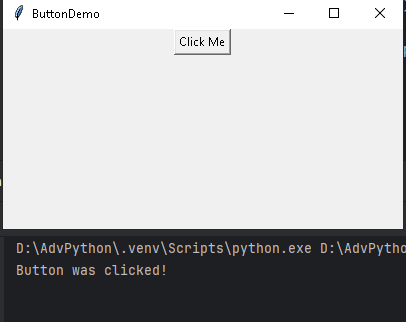
If you run the code…

Window appears with a button labeled "Click Me"
When you click the button: The button_click() function executes
Console displays: "Button was clicked!" each time you click
Window stays open until you close it (click X button)
Button widget options
Option Description Default Value Example Values
text Text displayed on the button "" "Click Me", "Submit"
textvariable Variable to control button text dynamically None tk.StringVar()
command Function to call when button is clicked None my_function
state Button state "normal" "normal", "disabled", "active"
width Button width in characters 0 (auto) 10, 20
height Button height in lines 0 (auto) 2, 5
font Text font System default ("Arial", 12), ("Helvetica", 14, "bold")
fg Text color (foreground) System default "red", "#FF0000", "white"
bg Background color System default "blue", "#0000FF", "lightgray"
activeforeground Text color when mouse is over System default "yellow", "#FFFF00"
activebackground Background color when mouse is over System default "darkblue", "#000080"
disabledforeground Text color when button is disabled System default "gray", "#808080"
borderwidth Width of button border 2 0, 5, 10
relief Border style "raised" "flat", "raised", "sunken", "groove", "ridge"
padx Horizontal padding inside button 1 5, 10, 20
pady Vertical padding inside button 1 5, 10, 20
image Image to display on button None tk.PhotoImage(file="icon.png")
compound Image position relative to text "none" "left", "right", "top", "bottom", "center"
cursor Mouse cursor when hovering "" "hand2", "arrow", "watch", "cross"
anchor Text positioning within button "center" "n", "s", "e", "w", "ne", "nw", "se", "sw", "center"
justify Text alignment when multiple lines "center" "left", "center", "right"
wraplength Wrap text at this width 0 (no wrap) 100, 200
underline Index of character to underline -1 (none) 0 (first char), 5
overrelief Relief when mouse is over Same as relief "raised", "sunken"
takefocus Whether button can get focus 1 (True) 0 (False), 1 (True)
highlightthickness Focus highlight thickness 2 0, 5
highlightcolor Focus highlight color System default "yellow", "#FFFF00"
highlightbackground Focus highlight color when not focused System default "gray", "#808080"
Common Methods for Button Widget
MethodDescriptionExample
config()Configure button optionsbutton.config(text="New Text")
cget()Get option valuetext = button.cget("text")
invoke()Programmatically click buttonbutton.invoke()
flash()Flash the button visuallybutton.flash()
bind()Bind event to buttonbutton.bind("<Enter>", on_hover)
focus_set()Set focus to buttonbutton.focus_set()
state()Get or set button statebutton.state(["disabled"])
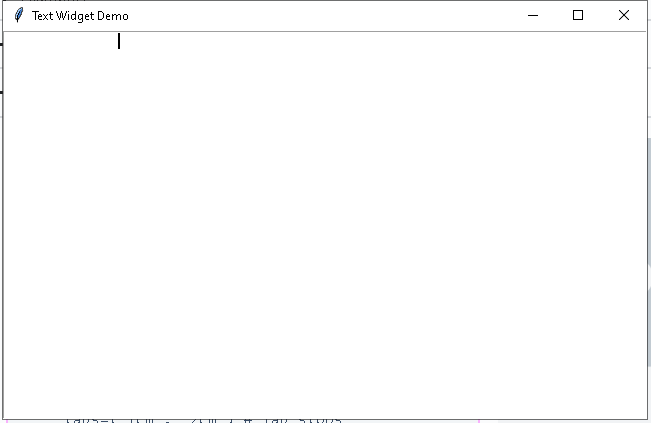
What is Text Widget?

The Text widget is a powerful multi-line text editor that supports:

  • Rich text formatting

  • Text styling and colors

  • Embedded images and widgets

  • Text searching and manipulation

  • Undo/redo capabilities

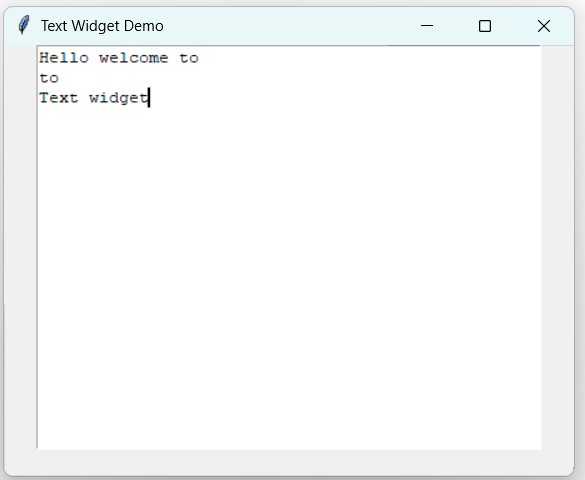
import tkinter as tk

root = tk.Tk()
root.title(‘Text Widget Demo’)
root.minsize(300, 200)

# Create a text widget
text1= tk.Text(root, width=50, height=20)
text1.pack()

root.mainloop()

import tkinter as tk
root = tk.Tk()
root.title('Text Widget Demo')
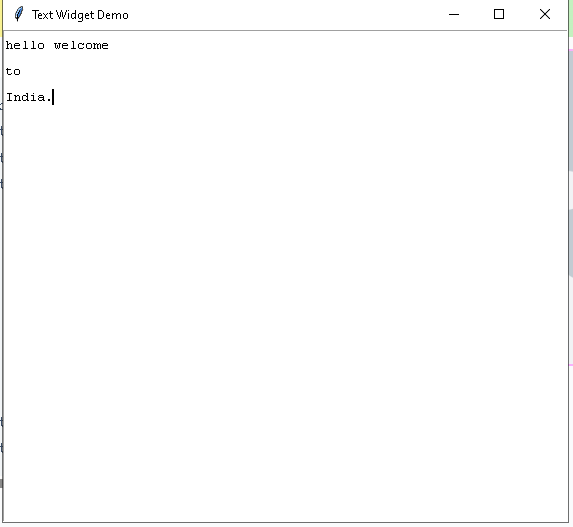
text_widget = tk.Text(
root,
width=80, # Characters wide
height=25, # Lines high
wrap="word", # Wrap options: "none", "char", "word"
spacing1=5, # Space above each line
spacing2=2, # Space between wrapped lines
spacing3=5 # Space below each line
)
text_widget.pack()
root.mainloop()
import tkinter as tk
root = tk.Tk()
root.title('Text Widget Demo')
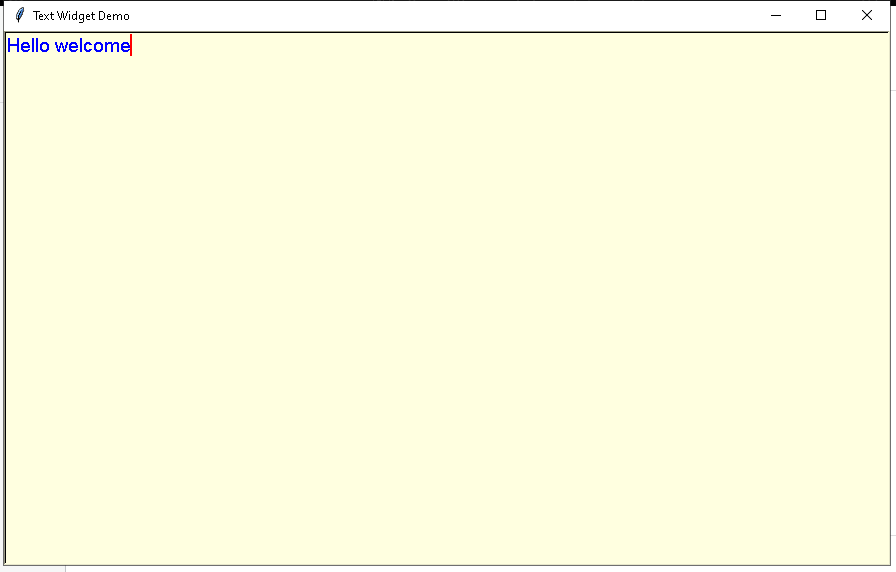
text_widget = tk.Text(
root,
font=("Arial", 14),
fg="blue",
bg="lightyellow",
selectbackground="lightblue", # Selection background
selectforeground="black", # Selection text color
insertbackground="red", # Cursor color
borderwidth=2,
relief="sunken"
)
text_widget.pack()
root.mainloop()


import tkinter as tk
root = tk.Tk()
root.title('Text Widget Demo')
text_widget = tk.Text(
root,
state="normal", # "normal" or "disabled"
undo=True, # Enable undo functionality
maxundo=-1, # Unlimited undo steps
autoseparators=True, # Auto separators for undo
tabs=("1cm", "2cm") # Tab stops
)
text_widget.pack()
root.mainloop()
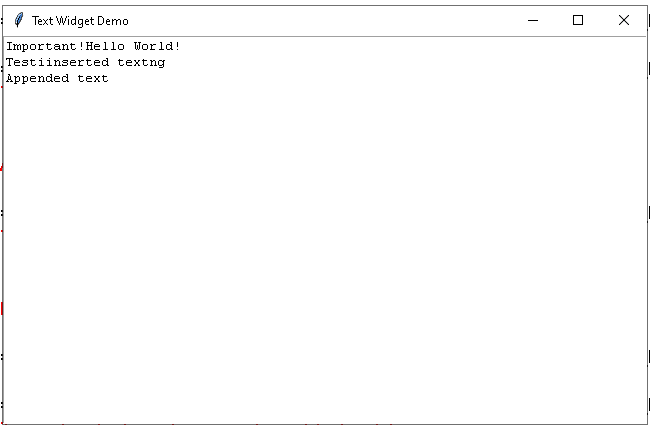
import tkinter as tk
root = tk.Tk()
root.title('Text Widget Demo')
# Basic insertion
text_widget.insert("1.0", "Hello World!") # Line 1, character 0
# Insert at specific positions
text_widget.insert("2.5", "inserted text") # Line 2, character 5
text_widget.insert("end", "\nAppended text") # End of text
# Insert with tags
text_widget.insert("1.0", "Important!", "important")
text_widget.pack()
root.mainloop()
What is a Frame Widget?

What is messagebox?

The messagebox module in Tkinter provides a set of dialog boxes for displaying messages or asking simple questions to the user. These are modal dialogs that pause the program execution until the user responds.

What are the features?

  • Modal dialogs (block program execution until closed)

  • Pre-built templates for common scenarios

  • Cross-platform compatibility

  • Easy to implement

How to import?

There are two common ways to import messagebox.

# Method 1: Import the entire module
import tkinter as tk
from tkinter import messagebox

# Method 2: Import specific functions
from tkinter import messagebox as mb

showinfo()
Function Return Values Data Type
showinfo(), showwarning(), showerror() “ok” str
askquestion() “yes”, “no” str
askokcancel() True, False bool
askyesno() True, False bool
askretrycancel() True, False bool
askyesnocancel() True, False, None bool/None